

Selling a house with problems in Lawrenceville, GA doesn’t mean waiting until every repair is finished or accepting whatever price a buyer feels like offering. We help homeowners weigh a fast, as-is cash sale against a traditional listing side by side, using the actual condition of the property and the seller’s real timeline, rather than pushing everyone toward the same solution.
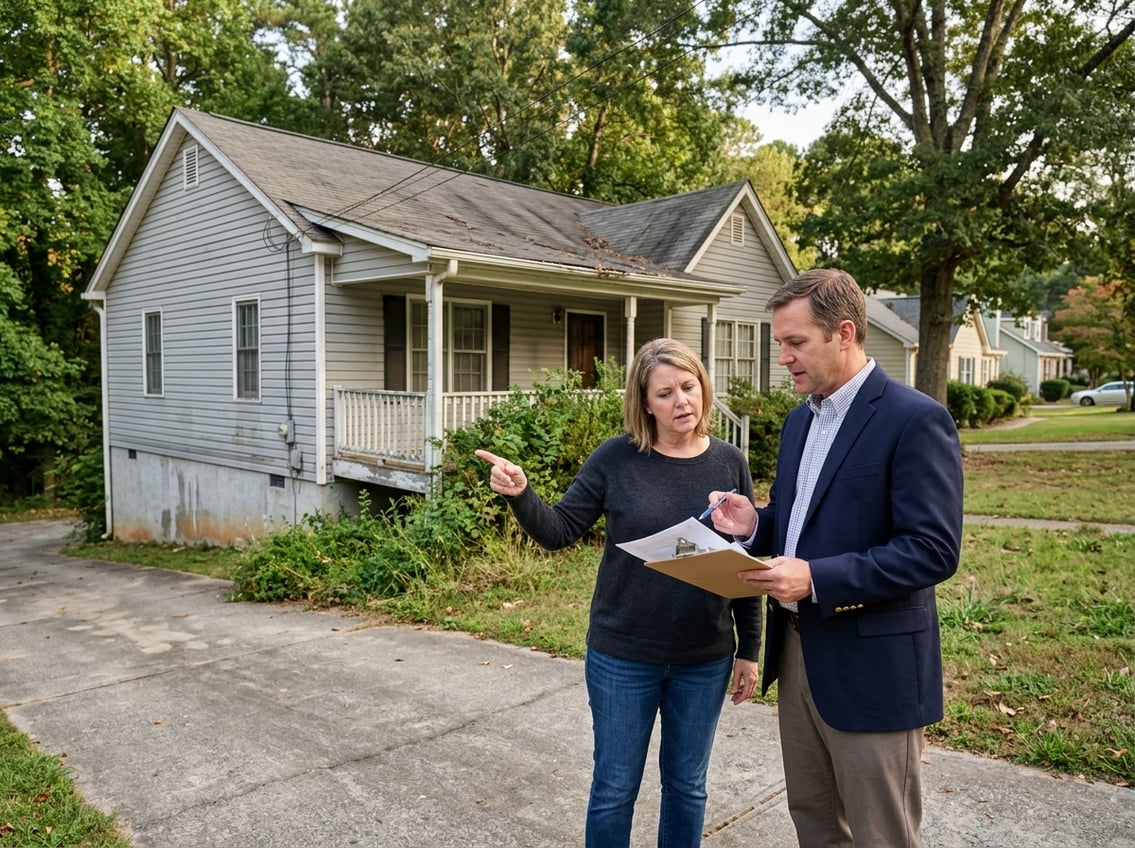
Coe Cameron is a licensed real estate professional based in Braselton, working with sellers throughout Lawrenceville and Gwinnett County who are managing repair-heavy homes, inherited property, vacant houses, tenant issues, or a sale that has to happen on a tight schedule.
Two paths are available for every property: a direct cash sale through a vetted network of proof-of-funds buyers, or a traditional listing with full MLS exposure aimed at top market value. Neither option is presented as automatically better, since the right fit depends on the home’s condition, the seller’s timeline, and the net proceeds each route is likely to produce.
Local knowledge of Lawrenceville neighborhoods, Gwinnett County market conditions, and Keller Williams backing supports both paths, so sellers get straightforward advice instead of a one-size-fits-all pitch.
Compare Cash Offers, Listing Costs, And Net Proceeds
The sale price a home could fetch on the open market and the amount a seller actually walks away with are often two very different numbers. A traditional listing typically involves agent commissions, closing costs, staging or repair expenses, and weeks or months of carrying costs while the home sits on the market. A cash sale skips most of those line items but usually comes in below full retail value, since the buyer is factoring in repair work and resale risk.
Coe Cameron provides a cash-offer-versus-listing report built around a specific property, not a generic estimate. That comparison lays out:
- What a cash buyer is likely to offer, based on condition and location
- What a listing might realistically net after commissions, closing costs, and any needed repairs
- How long each path is expected to take, from decision to closing
For direct cash sales, standard closing costs are covered and there are no agent commissions or hidden fees, which changes the math meaningfully compared to a retail sale. Sellers who want to see both numbers side by side, using their own property and financial goals, can request a no-cost home valuation and receive a comparison report within 24 hours by calling 678-469-6585 or visiting myhousesellsfast.org.
Property Problems Coe Cameron Can Help You Navigate
Homes rarely come with problems that fit neatly into one category, and that’s the case Coe Cameron works with most often. Deferred maintenance, outdated systems, cosmetic damage, and even significant structural issues do not need to be resolved before a conversation about selling starts. Properties are considered as-is, which means the seller isn’t expected to invest in repairs before a sale can move forward.
Situations regularly handled in Lawrenceville and across Gwinnett County include:
- Deferred maintenance or major repair needs, including roofing, plumbing, or foundation concerns
- Inherited or probate properties, where multiple heirs, unclear title, or an unfamiliar home add complexity
- Vacant homes that carry ongoing insurance, tax, or maintenance costs while sitting empty
- Tenant-occupied properties, including situations with a difficult tenant or lease conflicts
- Foreclosure or financial pressure, where timing matters more than maximizing every dollar
- Divorce, relocation, or downsizing, where a sale needs to happen on a defined schedule
Each of these situations changes which sale path makes more sense. A vacant home with no rush might do well on the open market, while a property tied up in probate with a court deadline may be a better fit for a faster, as-is transaction. Coe Cameron walks through the specifics of the property and the seller’s constraints before recommending a direction, rather than assuming the same answer applies to every case.
Choose The Right Sale Path For Your Timeline And Goals
Timeline and financial goals rarely point in the same direction, and that tension is usually what decides which sale path fits best. A homeowner who needs to close within a week or two, whether due to a job relocation, a foreclosure deadline, or an inherited property that’s become a financial burden, is generally better served by a cash sale. Closings can happen in as little as seven days, or on a seller’s preferred schedule when a bit more flexibility is available.
Sellers who have several months to work with, and whose primary goal is maximizing sale price, are often better positioned for a traditional listing. Full market exposure, professional marketing, and negotiation support can produce a higher sale price, though that path comes with showings, buyer financing contingencies, and the uncertainty of how long the home might sit before an accepted offer.
A few practical questions help clarify which route fits:
| Consideration | Favors Cash Sale | Favors Traditional Listing |
|---|---|---|
| Timeline | Days to a few weeks | Several weeks to months |
| Repair budget | Limited or none available | Repairs are feasible |
| Property condition | Significant repair needs | Move-in ready or minor updates |
| Priority | Certainty and speed | Maximizing sale price |
Coe Cameron reviews these factors against the specific property before recommending a direction, since the goal is matching the sale path to the seller’s actual circumstances rather than defaulting to whichever option is easiest to sell.
How The As-Is Sale And Listing Process Works
The process starts the same way regardless of which path a seller eventually chooses: a conversation about the property, its condition, and what needs to happen next. From there, the two paths diverge.
For a cash sale:
- Property details are reviewed and matched against a network of vetted, proof-of-funds buyers, including local fix-and-flip investors, regional buy-and-hold companies, and national iBuyers.
- An offer is presented with a proposed closing timeline.
- If accepted, closing can happen in as little as seven days, or later if the seller needs more time.
- Unwanted items can be left behind, and standard closing costs are covered.
For a traditional listing:
- A pricing and market analysis establishes a competitive listing price based on Lawrenceville and Gwinnett County market conditions.
- Professional marketing and MLS exposure, including promotion on platforms like Zillow and Google, generate buyer interest.
- Showings and offers are managed with negotiation support throughout.
- Closing follows standard financing and inspection timelines, which typically run longer than a cash sale.
Both paths start with the same no-cost valuation, giving sellers a clear picture of what each route is likely to produce before committing to one. That upfront comparison is what separates this process from a straight cash-offer pitch, since sellers aren’t asked to decide blind.
Why Lawrenceville Homeowners Choose Coe Cameron
Working with someone who actually knows Lawrenceville, and not a call center reading from a script, tends to matter most when a property has problems that don’t fit a standard sale. Coe Cameron is a licensed real estate professional backed by the Keller Williams network, which means sellers get access to established transaction support alongside a specialized buyer network built specifically for properties in as-is condition.
That buyer roster includes local fix-and-flip specialists who understand renovation costs in Gwinnett County, regional buy-and-hold companies, and national iBuyers, so a property’s condition and location can be matched with a buyer type that’s actually suited to it. Familiarity with Lawrenceville neighborhoods, zoning considerations, and current property values also shapes both the cash-offer comparison and any listing strategy that follows.
Customer feedback consistently points to clear communication and responsiveness, particularly during transactions on a tight timeline. Coe Cameron holds a 5.0 Google rating based on 25 reviews, is an A+ BBB Accredited Business, and has been featured in Atlanta Real Producers Magazine. Reviewers describe honest advice, effective marketing when a listing is the right fit, and steady support through inherited properties, foreclosure concerns, and other complex situations.
None of that changes the reality that every property is different. A home with significant structural issues won’t receive the same offer or timeline as one needing only cosmetic work, and that’s part of why the comparison process exists: to give sellers numbers based on their actual property rather than a generalized promise.
Service Areas Across Lawrenceville And Gwinnett County
Coe Cameron works with sellers throughout Lawrenceville and the surrounding Gwinnett County area, including neighborhoods such as Downtown Lawrenceville, Sugarloaf, Tribble Mill, Collins Hill, Chandler Pond, Rivermoore Park, Great River at Tribble Mill, Flowers Crossing, Stonehaven at Sugarloaf, Knollwood Lakes, Rivershyre, Bramlett Station, and White Oak Place.
Coverage extends across Lawrenceville ZIP codes 30043, 30044, 30045, and 30046, along with nearby communities including Grayson, Snellville, Loganville, Duluth, Suwanee, Buford, Sugar Hill, Norcross, Lilburn, Dacula, Auburn, Braselton, and areas near Château Élan.
Whether a property sits in a well-established Lawrenceville neighborhood or a growing pocket of unincorporated Gwinnett County, the same two-option approach applies: a no-cost valuation, a comparison of cash and listing numbers, and a recommendation based on the property’s actual condition and the seller’s timeline.
Sellers ready to see those numbers can reach Coe Cameron directly at 678-469-6585 or through myhousesellsfast.org. The team is based at 3730 Village Way, Suite 160, Braselton, GA 30517, and is available Monday through Saturday from 7:00 AM to 10:30 PM and Sunday from 12:30 PM to 10:30 PM. A phone call or a quick property submission is enough to start a valuation and get a side-by-side comparison of what a cash sale versus a traditional listing would look like for a specific Lawrenceville home.
Frequently Asked Questions
Can I sell a house in Lawrenceville, GA if it needs major repairs?
Yes. Homes with significant repair needs, including roofing, plumbing, electrical, or foundation issues, can be sold as-is through a cash sale, or listed traditionally with pricing that reflects the property’s condition. Coe Cameron reviews the specific repairs needed before recommending which path is likely to produce a better outcome.
Do I need to make repairs before selling a damaged or outdated home?
No repairs are required before selling as-is. A cash buyer accounts for needed work in the offer price, while a traditional listing can still move forward with an accurate disclosure and a price that reflects the home’s current condition rather than a fully renovated one.
Can I sell my house as-is without making any improvements?
Yes, Georgia law allows homes to be sold as-is, meaning the buyer accepts the property in its current condition and the seller isn’t obligated to complete repairs. Sellers still need to complete a Seller’s Property Disclosure Statement covering known defects, which is separate from the repair obligation.
What problems must I disclose when selling a home in Georgia?
Georgia sellers are generally expected to disclose known material defects on the Seller’s Property Disclosure Statement, which can include issues with the roof, foundation, plumbing, electrical systems, water intrusion, and past repairs. This applies whether the home is sold as-is or through a traditional listing, and specific disclosure questions should be reviewed with a real estate professional or attorney familiar with Georgia requirements.
How can I sell a house that is in poor condition if I cannot afford repairs?
A cash sale through a vetted, proof-of-funds buyer is typically the most direct option when repair costs aren’t feasible, since the buyer purchases the property in its current condition and covers standard closing costs. Requesting a no-cost valuation first shows what that cash offer would look like compared to a discounted traditional listing, so the decision is based on real numbers rather than assumptions.
Will foundation, roof, plumbing, or code issues prevent me from selling my home?
These issues do not prevent a sale, but they do affect pricing and which buyers are likely to be interested. Investors and cash buyers regularly purchase homes with foundation, roofing, plumbing, or code violation concerns, while a traditional listing may need a price adjustment and clear disclosure to attract a buyer comfortable with the needed work.
Sell House With Problems in Lawrenceville, GA: Your Options
If your Lawrenceville house needs a new roof, has foundation concerns, outdated plumbing, water damage, an old HVAC system, or simply hasn’t been updated in years, you may be wondering whether you can sell it without fixing everything first.
You can.
The bigger question is not simply, “Can I sell my house as-is?” It is:
Which way of selling makes the most sense for my house, my situation, and the amount of money I actually want to walk away with?
For some Lawrenceville homeowners, selling as-is to a cash buyer provides the speed and convenience they need. For others, putting the property on the market and giving buyers access to the home through the MLS may produce a better overall net—even if it takes longer and requires more preparation.
That distinction matters.
I’m Coe Cameron, a licensed real estate professional serving Lawrenceville and Gwinnett County, and I work with homeowners who are dealing with properties that aren’t necessarily “market ready.”
That can mean a house that has been neglected for years, a property inherited from a family member, a vacant house, a rental with tenant issues, a home that failed to sell, or a property where the owner simply doesn’t have the time or money to take on another major renovation.
Rather than automatically telling you to list—or automatically telling you to take a cash offer—the goal is to compare the two options and determine what makes the most financial sense for your specific property.
What Does “House With Problems” Mean in Lawrenceville?
A problem property doesn’t necessarily mean a condemned house or a complete fixer-upper.
Sometimes the problems are relatively minor. Other times, they can make a conventional sale considerably more complicated.
Here are some of the situations Lawrenceville homeowners commonly run into:
- An older roof that is near the end of its useful life
- Water damage or evidence of previous leaks
- Foundation or structural concerns
- Outdated electrical wiring or plumbing
- An old HVAC system
- Mold or moisture problems
- Termite or wood-destroying insect damage
- Fire or smoke damage
- Unfinished renovations
- Major cosmetic updating needed
- Overgrown landscaping or exterior maintenance
- A vacant property that has been sitting unused
- A rental property with tenant or lease complications
- Code or permitting concerns
- A house filled with unwanted furniture or personal belongings
- An inherited home that has not been updated
- A property that needs significantly more work than the owner can afford
The important thing is that a house doesn’t have to be perfect to be sold.
The condition simply affects who is likely to buy it, how the property should be priced, and which selling strategy makes the most sense.
Selling a Problem House in Lawrenceville: You Generally Have Two Main Options
Most homeowners considering an as-is sale should compare two basic strategies.
Option 1: Sell the House As-Is for Cash
A cash buyer may purchase the property in its current condition without requiring you to complete the same level of repairs and preparation normally associated with a retail listing.
That can be attractive if you have a property with substantial deferred maintenance or simply don’t want to spend months coordinating contractors.
The trade-off is important, though.
Speed and convenience can come at the expense of sale price.
A cash buyer has to consider renovation costs, financing or holding costs, resale risk, and the possibility that the actual repairs will cost more than expected. Those factors are reflected in the offer.
That’s why I don’t recommend looking at a cash offer by itself.
The better question is:
“What would I actually net from the cash sale compared with what I could reasonably net by listing the property?”
Option 2: List the Property Traditionally
The other option is to put the home on the open market.
A property doesn’t necessarily have to be completely renovated before it can be listed. Depending on the condition, it may be possible to sell it in its current state, make selected improvements, or price the property to account for the work a buyer will need to complete.
The advantage is exposure.
Instead of limiting the potential buyer pool to investors or cash buyers, the property can be marketed to owner-occupants, investors, first-time buyers, renovation buyers, and others who may be willing to take on the work.
The trade-off is that traditional sales can require more preparation, showings, inspections, negotiations, buyer financing, and time.
For a homeowner who has the flexibility to wait, that may be worthwhile.
For someone who needs the property sold quickly, it may not be.
Cash Sale vs. Traditional Listing: What Should You Compare?
Don’t compare the two options based only on the advertised sale price.
Compare the net proceeds and the amount of time, money, and effort required to get there.
For example, imagine a Lawrenceville homeowner has a property that could potentially sell for more after renovations.
That doesn’t automatically mean renovating is the best decision.
You could have:
- Contractor costs
- Roofing expenses
- HVAC replacement
- Plumbing or electrical work
- Flooring and painting
- Landscaping
- Cleaning and hauling
- Staging
- Realtor commissions
- Seller closing costs
- Property taxes
- Insurance
- Utilities
- Mortgage payments
- Additional months of ownership
A higher sale price doesn’t necessarily mean a higher amount of money in your pocket.
That’s why I use a cash-offer-versus-listing comparison when evaluating a property.
The objective is to look at the actual house and compare the likely outcomes rather than telling every homeowner the same thing.
What Happens If Your Lawrenceville House Needs Major Repairs?
One of the first things I want homeowners to understand is that you don’t necessarily need to repair everything before discussing a sale.
If you’re dealing with a roof problem, foundation issue, outdated kitchen, damaged flooring, plumbing problem, or another expensive repair, we can start by looking at the property in its current condition.
That doesn’t mean every problem property should automatically be sold to a cash buyer.
In fact, sometimes the numbers make more sense to list.
For example, a home that needs $15,000 in cosmetic work may be very different from a home that needs $75,000 or $100,000 in structural and mechanical repairs.
Location matters, too.
A property near Downtown Lawrenceville, along the GA-316 corridor, near Sugarloaf, Collins Hill, Tribble Mill, or another established part of Gwinnett County can have a different buyer pool and resale potential than another property with similar physical problems somewhere else.
Lawrenceville is not one uniform housing market. Neighborhood, lot size, age of the house, school assignment, street location, condition, and surrounding properties can all affect how buyers view a property.
The City of Lawrenceville itself maintains zoning, flood-zone, school-zone, ZIP-code, and other GIS information that can be relevant when evaluating a property.
Lawrenceville Location Can Make a Difference
A “problem house” in Lawrenceville shouldn’t be evaluated in isolation.
The surrounding area matters.
A house near Downtown Lawrenceville may appeal to a different buyer than one farther out toward the Tribble Mill area. A property near major roads such as GA-316, Highway 20, GA-124, or GA-120 may have different accessibility considerations than a similar house tucked inside an established residential subdivision. Lawrenceville’s location at the intersection of several major routes is one reason the city serves as an important hub within Gwinnett County.
The same goes for the condition of neighboring properties.
If most nearby homes are renovated and selling at strong prices, there may be an opportunity to position a fixer-upper differently than a property surrounded by other homes needing substantial work.
That is why a simple online estimate isn’t enough to determine what your property is worth.
What If the House Is Inherited?
Inherited homes are one of the situations where the condition of the property isn’t always the biggest problem.
The house may be outdated, but the bigger challenges can be deciding what to do with the property, determining who has authority to sell it, cleaning out personal belongings, coordinating multiple heirs, or dealing with probate and title issues.
If the property is sitting vacant, there can also be ongoing expenses while everyone decides what to do.
You may be able to sell the property as-is rather than spending months renovating a house that nobody in the family intends to keep.
But again, the right answer depends on the circumstances.
If there is a probate, title, estate, or legal issue involved, the appropriate attorney or closing professional should be consulted before assuming a transaction can close immediately.
What If You Can’t Afford the Repairs?
This is one of the most common reasons homeowners begin researching “sell my house as-is” or “sell house with problems in Lawrenceville GA.”
Maybe the roof needs replacement, but you don’t have $20,000 or $30,000 available.
Maybe the HVAC failed.
Maybe you’ve been paying for a vacant house while trying to decide what to do.
Or perhaps you simply don’t want to borrow money to renovate a property you’re planning to sell anyway.
In that situation, an as-is cash sale can be worth considering.
But don’t assume a cash offer is automatically the best deal.
Before accepting an offer, compare it against what the property might realistically produce through a traditional sale after accounting for the repairs, selling expenses, carrying costs, and additional time involved.
That’s where a side-by-side comparison becomes useful.
What About a House With Foundation, Roof, Plumbing, or Electrical Problems?
Major repair issues can make a conventional sale more challenging, but they don’t automatically make the property unsellable.
A buyer may be willing to purchase the property knowing that work is required.
The bigger issue is pricing and transparency.
For example, a buyer who discovers that a Lawrenceville house needs a new roof is going to factor that expense into the transaction. The same is true for foundation repairs, plumbing problems, electrical work, water intrusion, or other significant defects.
A seller should not assume that putting “AS-IS” in the listing eliminates every disclosure obligation.
Georgia real estate rules address disclosure of known adverse material facts, and the specific circumstances of a transaction can matter.
If you’re uncertain about what must be disclosed, it’s smart to discuss the issue with your real estate professional and, when appropriate, a Georgia real estate attorney.
How We Compare a Cash Sale With a Traditional Listing
I don’t believe homeowners should have to choose a selling strategy before they know what each option could realistically look like.
The process starts by looking at the property.
That includes things such as:
Property condition:
What actually needs to be repaired or replaced?
Location:
Where is the property located within Lawrenceville or Gwinnett County?
Recent comparable sales:
What have similar properties actually sold for?
Potential repairs:
Which repairs are necessary, and which improvements might simply be cosmetic?
Timeframe:
Does the homeowner need to sell in a matter of days, or can they wait several months?
Financial situation:
Are there mortgage payments, taxes, insurance, liens, or other carrying costs that need to be considered?
Seller’s priorities:
Is the primary objective maximum price, convenience, certainty, privacy, or speed?
From there, the numbers can be compared.
Cash Sale May Make More Sense When:
- The property needs substantial repairs
- You don’t want to manage contractors
- You don’t have the money to renovate
- You need a faster closing
- The property is vacant
- You’re dealing with an inherited property
- You need to simplify the transaction
- You’re facing a time-sensitive financial situation
Traditional Listing May Make More Sense When:
- The house is in reasonably marketable condition
- You have time to wait for a buyer
- You can afford necessary preparation
- There is strong demand for similar homes
- Your primary objective is maximizing the sale price
- The expected additional net proceeds justify the additional time and effort
There isn’t one answer that works for every Lawrenceville homeowner.
The numbers should determine the answer.
What About Downtown Lawrenceville and Older Homes?
Older properties can require a different evaluation than newer subdivision homes.
Lawrenceville has a long history—the city was incorporated in 1821 and is the county seat of Gwinnett County. Its downtown area includes the historic courthouse area, Lawrenceville Lawn, the Depot District, and other established parts of the community.
That history also means some properties in and around Lawrenceville have more age-related maintenance issues than newer construction.
Older homes can have combinations of:
- Aging plumbing
- Older electrical systems
- Foundation movement
- Crawl-space concerns
- Roof deterioration
- Previous additions
- Outdated kitchens and bathrooms
- Deferred exterior maintenance
- Older HVAC systems
Those issues don’t automatically make a property a bad investment or a bad sale candidate.
They simply need to be reflected accurately in the evaluation.
What If the House Has Been Sitting Vacant?
Vacant properties can become expensive surprisingly quickly.
Even if nobody is living in the house, the bills don’t necessarily stop.
There can still be:
- Property taxes
- Insurance
- Utilities
- Lawn maintenance
- Pest control
- Repairs
- Security concerns
- HOA obligations, where applicable
- Mortgage payments
- Cleanup and property maintenance
A small maintenance problem can also become a much larger problem when nobody is regularly checking the property.
If you have a vacant house in Lawrenceville that needs work, it’s worth calculating the cost of continuing to hold it while deciding what to do.
What If You’re Facing Foreclosure or Financial Pressure?
If the reason you’re selling is financial hardship, don’t wait until the situation becomes an emergency before looking at your options.
A house with equity may still provide solutions, but the timeline matters.
If there are mortgage arrears, tax issues, liens, bankruptcy considerations, or a scheduled foreclosure sale, you should get appropriate professional advice immediately. A real estate professional can help evaluate the property’s marketability, but an attorney or other qualified professional may be needed for legal or debt-related questions.
The sooner the property is evaluated, the more options you may have.
Why Work With a Local Lawrenceville Real Estate Professional?
A property isn’t just a four-bedroom house with a ZIP code.
Its location within Lawrenceville matters.
The relationship between the property and nearby homes matters.
The condition of the neighborhood matters.
Recent sales matter.
And the type of buyer likely to purchase the property matters.
That’s particularly important when a house has problems.
I work with homeowners throughout Lawrenceville and Gwinnett County, including areas around Downtown Lawrenceville, Sugarloaf, Collins Hill, Tribble Mill, and surrounding communities.
The goal is straightforward: help you understand what your property could realistically do on the open market and what an as-is sale might look like before you make a decision.
If the traditional listing route is likely to put more money in your pocket after expenses, that’s an important thing to know.
If the convenience and speed of an as-is sale make more sense for your circumstances, that’s important to know, too.
You shouldn’t have to choose a selling strategy based on a sales pitch.
Get a Lawrenceville Home Value and Compare Your Options
If your Lawrenceville home needs repairs, you don’t have to decide today whether you should renovate it, list it, or sell it for cash.
Start with the numbers.
We can look at the property’s current condition, location, likely repair requirements, comparable sales, and your desired timeline.
Then compare:
Cash Sale → What could you potentially receive for the property as-is?
Traditional Sale → What could you potentially net after repairs, commissions, closing expenses, carrying costs, and other selling costs?
Timeline → How quickly could each option realistically happen?
Effort → How much work would each option require from you?
That gives you something much more useful than a generic home-value estimate: a property-specific comparison of your actual choices.
For a no-cost property valuation and cash-versus-listing comparison, contact Coe Cameron at 678-469-6585 or visit My House Sells Fast.
You can start with the house exactly as it is today.
No need to clean it up for the conversation. No need to replace the roof first. And no need to decide whether you’re selling for cash or listing traditionally before you understand the numbers.
Frequently Asked Questions
Can I sell a house in Lawrenceville, GA if it needs major repairs?
Yes. A property that needs significant repairs can potentially be sold as-is or listed traditionally. The condition will affect the price, buyer pool, and marketing strategy, but a damaged or outdated house isn’t automatically unsellable.
Do I need to repair my house before selling it?
Not necessarily. Depending on the property’s condition, you may be able to sell it as-is. A cash buyer may purchase the property in its current condition, while a traditional buyer may also be willing to purchase a home that needs work if the price reflects the repairs.
Can I sell my Lawrenceville house as-is?
Yes. Selling as-is means the property is being offered in its current condition. However, “as-is” should not be treated as a blanket exemption from applicable disclosure requirements. Sellers should disclose known material issues as required and seek professional advice when unsure about a specific situation.
Will a bad roof prevent me from selling my house?
Not necessarily. A roof that needs replacement can affect the property’s value and the types of buyers interested in it. Some buyers may want the roof repaired before closing, while others may purchase the property with the cost of replacement reflected in the price.
Can I sell a house with foundation problems in Lawrenceville?
Potentially, yes. Foundation concerns can significantly affect a property’s value, but they do not automatically prevent a sale. The severity of the issue, documentation, repair estimates, location, and buyer pool all matter.
What if my house needs plumbing or electrical work?
You may still be able to sell it without completing the work yourself. The important step is determining the scope of the problem and understanding how that condition affects the property’s likely market value and buyer demand.
Can I sell an inherited house in Lawrenceville without fixing it up?
Often, an inherited property can be sold in its existing condition. However, probate, estate authority, title, liens, and multiple-heir situations can affect the transaction. If the estate has legal complications, consult the appropriate attorney or closing professional.
Is selling for cash always better than listing my Lawrenceville house?
No. A cash sale may provide speed and convenience, but a traditional listing could potentially produce more money. The right choice depends on the property’s condition, repair costs, marketability, expenses, and your timeline.
How do I know whether I should sell my Lawrenceville house for cash or list it?
Compare the expected net proceeds—not just the headline sale price. Look at the likely cash offer, potential retail sale price, repairs, commissions, closing expenses, carrying costs, timeline, and the amount of work involved.
How quickly can I sell a house with problems?
The timeline depends on the property, title, buyer, financing, inspections, and closing requirements. A cash transaction may be capable of closing considerably faster than a traditional financed sale, but the exact timeline should be established after reviewing the property and transaction.
What areas around Lawrenceville do you serve?
Service can extend throughout Lawrenceville and Gwinnett County, including areas around Downtown Lawrenceville, Sugarloaf, Collins Hill, Tribble Mill, and surrounding communities. Nearby markets include Grayson, Snellville, Loganville, Duluth, Suwanee, Buford, Sugar Hill, Norcross, Lilburn, Dacula, Auburn, Braselton, and other parts of the greater Gwinnett County area.
What should I do first if my Lawrenceville house has problems?
Don’t automatically spend thousands of dollars on repairs before determining whether those repairs will actually increase your net proceeds.
Start by getting the property evaluated in its current condition.
Then compare the numbers for an as-is cash sale against a traditional listing.
That way, you can make the decision based on your property, your finances, your timeline, and your goals—not someone else’s sales pitch.